

Winter 2026 Member Meeting — The Ethical Next Step: Data Policy on the AI Frontier
Green The Bid’s Winter 2026 Member Meeting featured a powerful presentation The Ethical Next Step: Data Policy on the AI Frontier with guest speakers Jaclyn Paris and Victoria Harvey, a daring duo leading us on the AI frontier.
Both guest speakers are active participants in the Green The Bid community, contributing foundational knowledge into our resources such as “The Green Post Manual” and “Hard Drive Re-use Best Practices.” Jaclyn Paris has 20+ years of experience in broadcast, commercial, documentary, and branded content creation. Today she is the Head of Development at Cosmo Street, as well as a student at Emory University’s Center for Ethics, working towards a certificate in ethical AI and navigating the intersection of media and technology. Victoria Harvey has worked in advertising post-production for 10+ years and carbon accounting for seven. She is the Co-founder of Advertising Environmental Consultancy Clima and Sustainability Consultant at Film Locker. She recently carried out academic research on the effects of advertising on the climate.
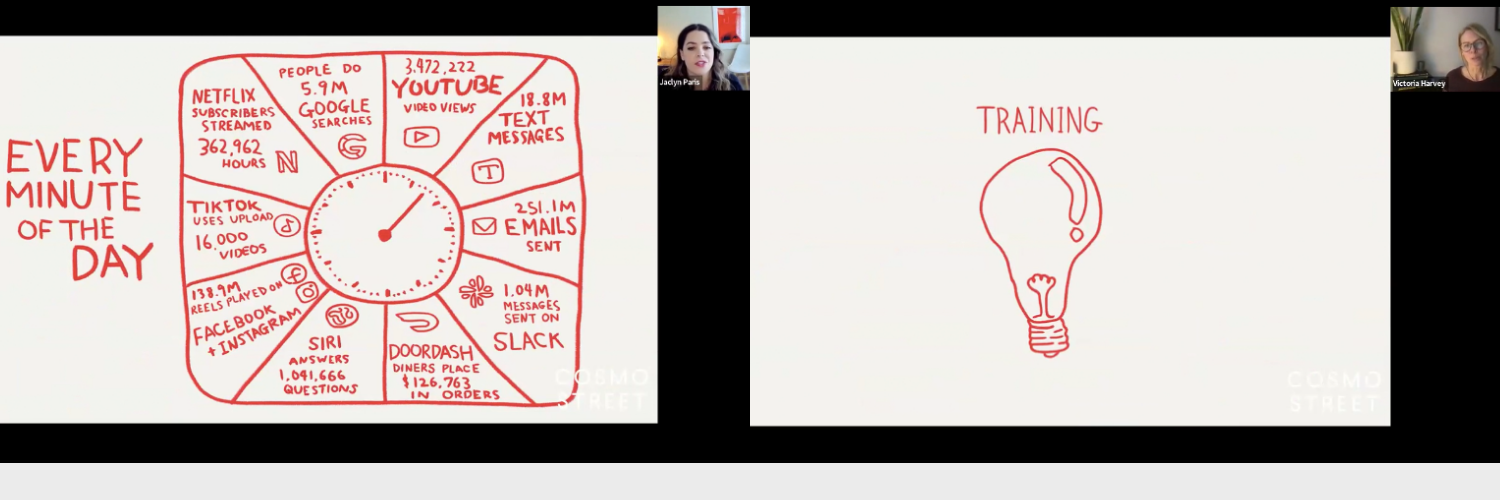
Jaclyn opened the presentation on the radical shift that comes with viewing digital files as waste, rather than solely considering the physical pollution of a production. She continued painting the picture of our current digital landscape and the acceleration of digital waste with the emergence of AI, emphasizing that “files aren’t ephemeral and sitting cleanly in this abundant white cloud. There’s an environmental impact of your data, of files, of your iterations, of your prompts. I’m challenging you to re-imagine data as physical things taking up space, weighing something, sounding as real to your ears as generators on set or in your hand, like plastic cutlery. To do this, you have to discard the image of clouds.” Data centers producing AI work are giant media campuses emitting methane carbon, with the carbon impact of data servers eventually expected to surpass that of global aviation.
Jaclyn turned over the conversation to Victoria to detail how carbon accounting works, what its limitations are, and how we should interpret the results. To explain it, she compares the “spend based accounting approach in carbon calculation to the cost of bread, where the wheat would’ve had to have been grown in the fields plowed by diesel tractors, cut and sifted, packaged, and transported to the shop. We account for all the money that changes hands, and attribute a few cents of that to my final loaf of bread. Every fraction of a penny across those diverse supply chains is accounted for. We can do the same with carbon. We can do this by applying an environmentally extended input-output figure in carbon accounting. We match a unit of carbon to a unit of spend.”
The other way to do a carbon footprint is to do a “lifecycle assessment” in which you look at a specific product and we estimate just a few stages of the supply chain. Lifecycle assessments have a very narrow boundary and don’t provide a full picture. The best accounting uses both approaches, she notes, and we must move away from the narrative that we can plug stuff into a calculator and think this is an absolute figure of the carbon footprint of the plan, service, or product. “When we think about carbon and AI we need to think about big ticket issues: Training, Water, Hard Drives, and Methane – all necessary elements to consider in accounting carbon. “Carbon accounting is at best an estimate due to the way we use spend-based emissions. We need to make sure we watch out for what is and isn’t included in calculators.”
The meeting brought valuable insight into reframing the way our industry envisions data storage, AI for creativity, and carbon calculating. So what can people do to tackle this issue? Creating a multi-stakeholder green team, evaluating how your team is using AI currently, creating a glossary of terms and evaluated tools (with a potential red, yellow, green light framework) and, ultimately, developing a data plan are key to helping manage the growing and rampant footprint from AI and other data creation. “Complex systems are often reduced to clean little metrics and single reported calculations. The problem there is that when we collapse complexity into just a number, we strip away a lot of context,” says Jaclyn. “The work of GTB’s members is to resist flattening in order to surface what’s excluded, to name limitations, and to restore the full picture of AI.”
In this journey, Jaclyn reminds us, “You’re going to need to be willing to disagree with others. Greenwashing might come from sources you least expect; that stakeholders may find it in their interest to convince you that AI is actually a really clean option, or it has a really small footprint. Maybe because it’s better for their bottom line or their carbon calculations or their KPIs. Your role is to stay sharp, to question the story, to snuff out the stuff that sounds too good to be true.”